All docs pages
Co-pilot Signal States
The Co-pilot on the Commander tab looks for confirmed price setups with supporting options context. This page explains its states and the reasons a signal may be waiting or blocked.
- The Co-pilot moves through a small set of states: SCANNING, SETUP FORMING, SIGNAL LIVE, MANAGING, COOLDOWN, and STAND DOWN.
- Entry and targets appear only while a signal is live. The rest of the time you get a plain "watching, no play yet" line — that is the design, not a broken screen.
- A live play shows a direction bias — CALLS (▲) or PUTS (▼) — with an entry and targets.
- The 0–100 number is a confluence score, not a win probability.
- A named setup still needs its listed chart trigger before a signal can go live.
- If the live flow feed drops, the Co-pilot withholds plays rather than guessing — silence is a signal.
- Educational context only. None of this is financial advice.
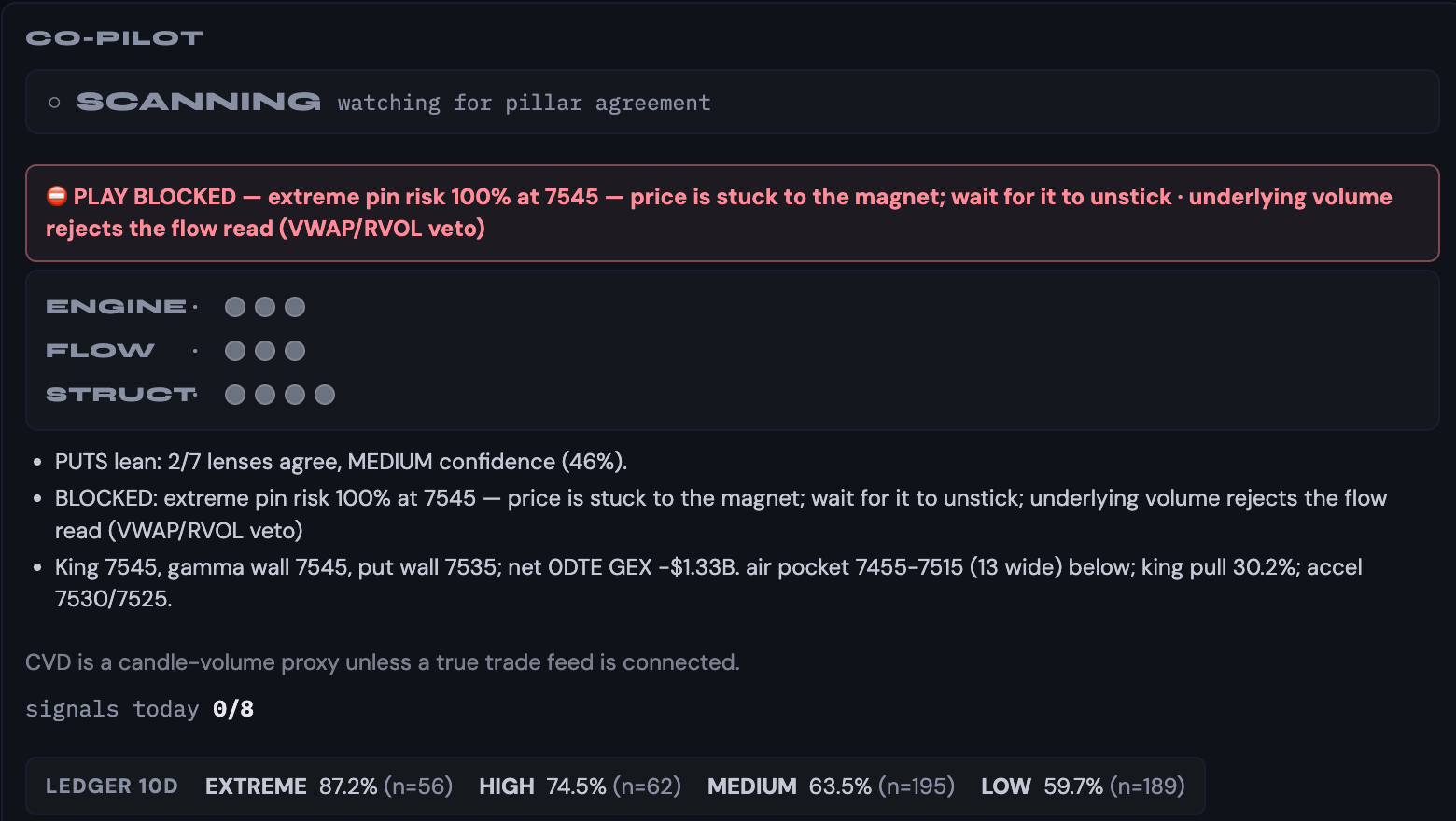
Read the state before you read anything else on the card. It tells you whether the Co-pilot is idle, warming up, firing, or standing aside — and that frames everything below it.
The state machine
The Co-pilot advances through states as conditions line up and then resolve. Each state has its own glyph and a short sub-line explaining what it is waiting on or watching.
| State | What it means | What to do |
|---|---|---|
| ◦ SCANNING | The Co-pilot is watching price structure and options context. The sub-line explains any missing input or qualification. | Nothing. This is the honest baseline — most of a session lives here. |
| ▲ SETUP FORMING | A continuation or reversion setup is forming. The trigger-watch line names the price event still required. | Get ready, not in. A setup can dissolve before it ever becomes a signal. |
| ● SIGNAL LIVE | The checks agree. The card shows a direction (CALLS ▲ or PUTS ▼) with the entry and targets it fired on — direction and plan always come from the same read, frozen at fire time. | This is the one moment the Co-pilot is actively pointing at a play. Confirm it against your own read. |
| ◈ MANAGING | A play is already open on one side. The sub-line reads "managing {direction} — no re-fire this side" — it will not stack a second signal in the same direction. | Manage the open idea. Do not expect a fresh entry on this side while it is live. |
| ◷ COOLDOWN | A same-side lockout after a play resolves, with a "resets in m:ss" countdown. This prevents an instant re-fire in the same direction. | Wait for the countdown. The Co-pilot is intentionally sitting on its hands. |
| ⛔ STAND DOWN | No clean setup — the Co-pilot is standing aside on purpose. The sub-line states the reason (default: "no clean setup"). | Stand aside with it. A forced trade here is exactly what this state exists to prevent. |
The PLAY BLOCKED banner
Sometimes a red ⛔ PLAY BLOCKED banner sits above the reasoning. It is a hard veto: even when the Co-pilot has a lean, a safety check has ruled the play out, so no entry appears while the block stands. The banner names the reason in plain words — for example, pin risk holding price against a magnet. It clears on its own once that condition passes.
Price confirmation, supporting context, and execution
The 0–100 score measures how much the engine's evidence agrees. It is deliberately labeled confluence, not probability: 80/100 does not mean an 80% chance of winning.
A signal requires fresh completed bars, a confirmed price event, supporting options flow or dealer context, and an executable contract. The context score describes the broader evidence; it does not independently authorize or veto an entry. The app and Discord use the same approved engine signals.
Freshness chips on the entry
When a play is live, the entry carries a small freshness chip so you know how current the number is:
- live — the entry was stamped from a live quote at the moment you loaded the card.
- ⚠ stale 12s — a live quote was unavailable, so the entry is off a snapshot, with its age in seconds. Confirm it against the tape before you act on it.
The wider Commander tab also shows freshness on its data badges — a DATA DELAYED or CLOSED chip when the feed is behind or the market is shut. See Data & Freshness for how the whole app timestamps itself.
When the flow feed goes dark
The Co-pilot reads several inputs. One of them is a live order-flow lens. When that feed is unavailable, the console does not paper over the gap — it withholds the play and tells you why.
- The order-flow panel shows NO FLOW DATA — live order flow unavailable (source down or not yet warmed).
- The Co-pilot may report Play withheld — flow lens dark and stay read-only until full data returns.
- The tab may drop into a reduced mode — a GEX-ONLY badge marks it: the live flow feed is offline, so you are seeing dealer-gamma levels only, without the flow lens.
Budget chips on the contract
When a play surfaces a contract, a small budget chip flags its per-contract premium as a built-in guardrail: $X/ct ✓ budget, $X/ct · over $500, or $X/ct ⚠ OVER CAP.
v8 also requires an executable ask, delta between 0.25 and 0.60, and a spread no wider than 18%. The ledger grades entry at ask and exit at bid.
Common questions
- The Co-pilot has said SCANNING for an hour. Is it broken?
- Check the displayed reason. A missing price trigger, unavailable data, and a cooldown are different conditions. Setup Status identifies what is keeping the engine from issuing a signal.
- Why do I see a bias but no entry price?
- A directional read still needs a confirmed price event, supporting context, and a contract that passes execution checks. Setup Status shows which condition is missing.
- What does Play withheld — flow lens dark mean?
- The live flow feed is offline, so the Co-pilot is running on partial inputs. It refuses to issue an actionable play on incomplete data and stays read-only until the full feed returns.
- Should I take a SIGNAL LIVE automatically?
- No. Every state on this card is educational context for your own read, not financial advice. A live signal is one input among many — confirm it against price, the levels, and your own plan before doing anything.